
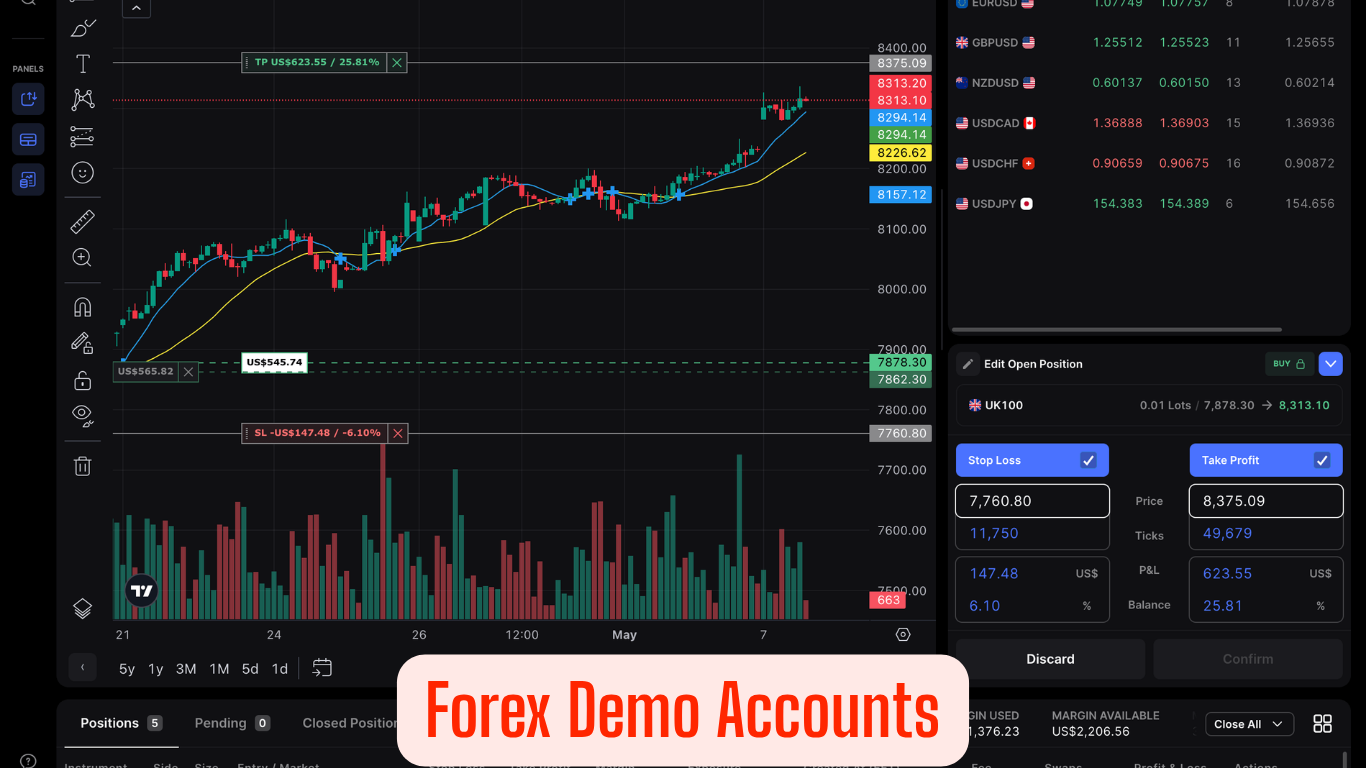
Forex trading presents a world of opportunity, but stepping into the largest financial market without preparation can be daunting. A Forex demo account is the essential tool that bridges the gap between theoretical knowledge and practical, real-world trading. It provides a simulated trading environment where you can execute trades, develop strategies, and learn the intricacies of the market using virtual funds, entirely without financial risk. This guide will explore not only what a demo account is but also how to leverage it to build a solid foundation for your trading career, ensuring you are well-prepared when you transition to live markets.
What is a Forex Demo Account?
A Forex demo account is a practice trading account offered by brokers that fully simulates a live trading experience. It operates using real-time market data and quotes, allowing you to place buy and sell orders on currency pairs and other instruments exactly as you would with a live account . The fundamental difference is that every trade is executed with virtual money, meaning any profits you earn are virtual, and any losses you incur have no impact on your real finances .
For both newcomers and seasoned traders, a demo account serves as a critical testing ground. Beginners can use it to understand how Forex trading works, while experienced traders can test new strategies or familiarize themselves with a new broker’s platform without risking capital . It’s a risk-free environment to make mistakes, learn from them, and build confidence.
The Multifaceted Benefits of a Demo Account
Leveraging a demo account effectively can dramatically accelerate your learning curve. Its benefits extend far beyond simple familiarization.
- Risk-Free Skill Development: A demo account is the perfect sandbox for learning. You can practice executing trades, understand what drives price movements, and get a feel for the market’s volatility, all without the fear of losing your hard-earned money . This safety net encourages exploration and learning from errors.
- Trading Platform Familiarity: Most brokers use complex platforms like MetaTrader 4 or 5 (MT4/MT5). A demo account allows you to learn the interface, practice placing different order types (market, limit, stop-loss, take-profit), and use built-in analytical tools and indicators without pressure .
- Strategy Testing and Refinement: A demo account is an ideal laboratory for developing and testing trading strategies. You can validate your ideas under real market conditions, see how they perform during different market sessions, and refine your approach before putting real capital on the line . This process helps you understand the frequency of trading, and the strings of wins and losses a strategy can produce.
- Emotional Control and Discipline: One of the most underrated benefits is the opportunity to practice emotional control. While the money is virtual, the experience of seeing trades go for or against you helps you recognize emotions like excitement after a win or frustration after a loss . Practicing how to stay disciplined and stick to your trading plan during these moments is invaluable preparation for live trading.
- Broker Evaluation: Before depositing funds, a demo account allows you to evaluate a broker’s services. You can assess their platform’s user-friendliness, the speed of trade execution, the quality of customer support, and the spreads they offer .
The Inherent Limitations and Hidden Dangers
While incredibly useful, demo accounts have significant limitations that traders must acknowledge to avoid costly mistakes later.
- The Psychological Gap is Real: The most significant difference between demo and live trading is psychology. Without real money at stake, the intense emotions of fear and greed are largely absent . A losing trade on a demo account is a mere statistic; the same trade with real capital can trigger panic or desperation, leading to poor decisions like moving stop-loss orders or abandoning your strategy .
- Unrealistic Trading Conditions: Demo accounts can create a slightly “idealized” trading environment. They often feature smoother and faster trade execution without the slippage (the difference between the expected price of a trade and the price at which the trade is actually executed) that is common in live markets, especially during high-volatility news events . Furthermore, the spreads (the difference between the bid and ask price) on demo accounts are sometimes tighter than those on live accounts .
- Risk of Developing Bad Habits: The sense of complete safety can be dangerous. Traders may be tempted to take excessive risks, use unrealistically high leverage to chase massive virtual profits, or neglect risk management rules—behaviors that would quickly wipe out a live account . Treating the demo account like a game can instill habits that are hard to break when real money is involved.
Best Practices for Effective Demo Trading
To maximize the value of your demo experience, you must treat it with the same seriousness as a live account.
- Simulate Realistic Conditions: Use a demo balance that reflects the actual capital you plan to start with in your live account. Trading with a virtual $100,000 when you only intend to deposit $1,000 can foster poor risk management and unrealistic expectations .
- Adhere to a Formal Trading Plan: Don’t trade randomly. Develop a trading plan that defines your strategy, including your entry and exit rules, the markets you will trade, and your trading schedule. Practice executing this plan meticulously on your demo account .
- Implement Strict Risk Management: Practice proper risk management from day one. Decide on a fixed percentage of your capital you are willing to risk per trade (commonly 1-2%) and use stop-loss orders on every position . This discipline is a cornerstone of successful trading.
- Maintain a Detailed Trading Journal: Keep a log of every trade you place. Record the reason for entry and exit, the outcome, and, crucially, your emotional state. Reviewing this journal regularly will help you identify patterns in both your strategy and your behavior that need improvement .
- Set a Clear Goal and Transition Plan: Avoid the trap of “demo purgatory,” where you practice indefinitely out of fear. Set a clear goal, such as achieving three consecutive months of consistent, disciplined trading based on your plan . Once you hit your goal, it’s time to transition to a live account with a small amount of capital.
When and How to Transition to Live Trading
Knowing when to make the jump is crucial. You are likely ready to transition when you consistently follow your trading plan, maintain emotional control during both winning and losing streaks, and have proven your strategy’s effectiveness over dozens of trades in the demo environment .
When you do transition, start small. Open a live account with a minimal deposit, perhaps using a micro or cent account that allows you to trade with very small position sizes . This approach lets you experience the psychological pressures of real trading while limiting your financial exposure. Continue to use your demo account to test new ideas, but apply only proven strategies to your live account.
Disclaimer: This article is for informational and educational purposes only and does not constitute financial advice of any kind. Trading Forex and CFDs involves a high level of risk and is not suitable for all investors. There is a possibility that you could sustain losses exceeding your initial deposit. You should be aware of all the risks associated with Forex and CFD trading and seek advice from an independent financial advisor if you have any doubts. The results from demo trading are not a guarantee of future performance in live trading.
FAQs
1. What is the main difference between a Forex demo account and a live account?
The primary difference is the absence of real financial risk. A demo account uses virtual funds, allowing you to practice trading and learn the platform without losing real money. A live account involves your actual capital, where profits and losses are real. Crucially, the psychological pressure is entirely different; the fear and greed associated with risking real money in a live account can significantly impact decision-making, which isn’t present in a demo environment.
2. How long should I use a demo account before trading with real money?
There is no universal timeframe, as it depends on your individual learning curve. Instead of focusing on time, set performance-based goals. You are likely ready to transition when you can consistently execute a trading plan, maintain discipline during losing streaks, and have achieved a track record of consistent, disciplined trading over a period of at least 2-3 months. The key is to move on once you are competent, not to stay in the demo account indefinitely out of fear.
3. Can I really lose money on a Forex demo account?
No, you cannot lose real money on a demo account because all trades are executed with virtual funds provided by the broker. Any losses are simulated and do not impact your personal finances. However, the bad habits and poor risk management you might develop while using a demo account can lead to significant financial losses once you transition to a live account.
4. Why are my trading results on a demo account often better than on a live account?
This common experience is typically due to two key factors:
- Psychology: The lack of emotional pressure on a demo account allows for clearer, more disciplined decision-making. With real money at stake, emotions like fear and greed can cause you to deviate from your strategy.
- Execution Differences: Demo accounts sometimes offer idealized conditions, such as instant trade execution and no slippage. In live markets, especially during volatile periods, you may experience slower execution and slippage, which can slightly worsen your entry and exit prices.
5. Can I use a demo account to test a new broker?
Absolutely. Using a demo account is one of the most effective ways to evaluate a new broker before depositing any funds. It allows you to test the speed and reliability of their trading platform, the quality of their customer support, the competitiveness of their spreads, and the overall user experience without any obligation or risk.