
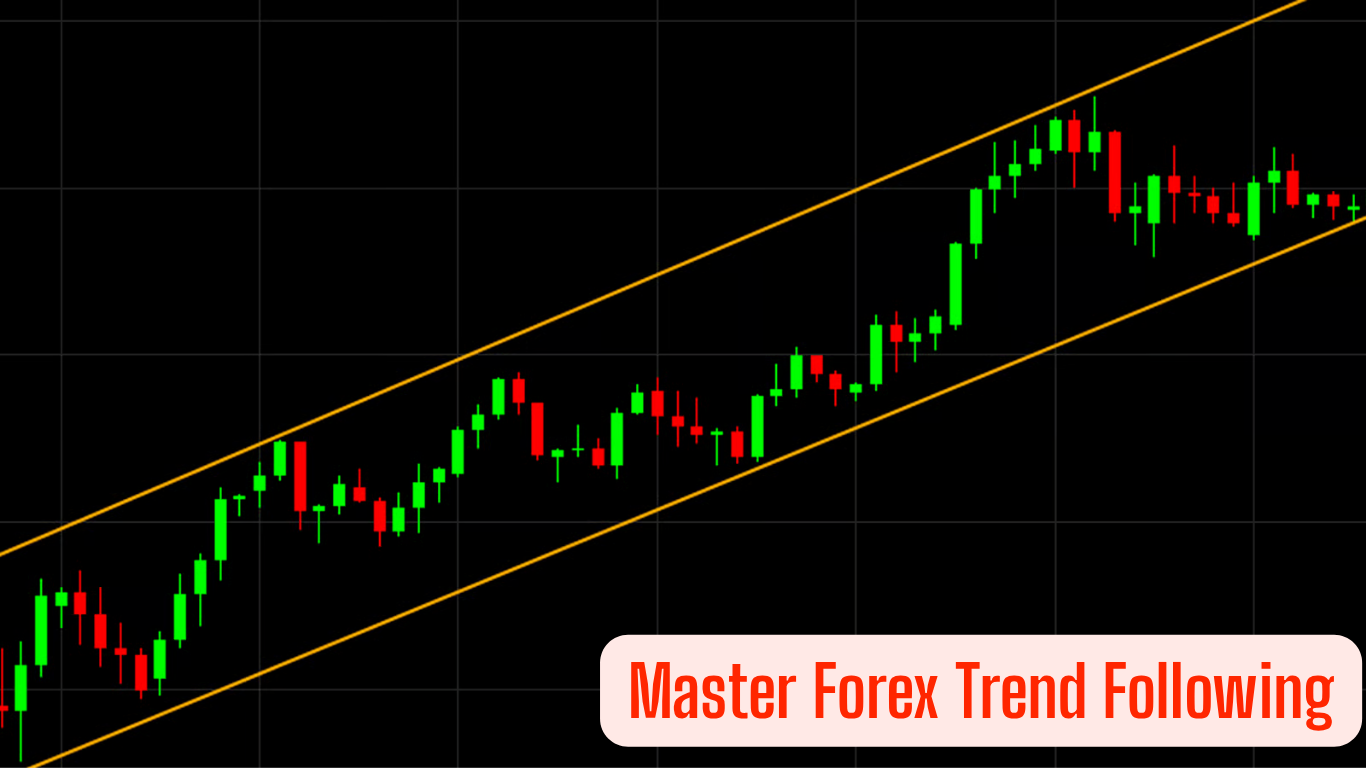
Forex trend following is a time-tested trading methodology designed to capture significant price movements in currency pairs. Instead of predicting market tops and bottoms, trend followers react to the market’s direction, aiming to profit from the “meat” of a sustained move. This approach is built on the simple philosophy that “the trend is your friend,” and by systematically following established directions, traders can potentially achieve substantial long-term gains .
This comprehensive guide will walk you through the core concepts, essential tools, and practical steps to build a robust Forex trend-following strategy.
Core Concepts and Key Advantages of Trend Following
At its heart, a Forex trend-following strategy involves identifying an existing market trend and entering trades in its direction. An uptrend is defined by a series of higher highs and higher lows (HH/HL), while a downtrend consists of lower lows and lower highs (LL/LH) . The goal is not to catch the very start or end of a trend, but to capture a large portion of the middle move.
This strategy offers several key advantages:
- Simplicity and Clarity: It removes emotional, complex decision-making by focusing on objective market direction .
- Profit Potential: By staying with a trend, traders can capture large, sustained price movements that short-term strategies might miss .
- Reduced Overtrading: It encourages patience, helping traders avoid frequent entries and exits, which cuts down on transaction costs and stress .
However, it’s crucial to understand the disadvantages. Trend-following indicators often lag behind price action, leading to delayed entries and exits . Furthermore, the strategy can struggle in ranging or choppy markets, and traders face the constant risk of false breakouts where a trend appears to start but then quickly reverses .
Essential Tools and Indicators for Identifying Trends
Successful trend following relies on using technical indicators to confirm the market’s direction and find optimal entry points. The most effective strategies combine several of these tools instead of relying on a single one.
A Step-by-Step Trend Following Trading Plan
Executing this strategy effectively requires a structured, disciplined plan. Here is a step-by-step guide to implement a trend-following trade.
- Select the Right Market and Timeframe: Begin with major currency pairs known for clear trends, like EUR/USD or GBP/USD . Decide on your trading style—long-term (daily/weekly charts) or short-term (hourly/4-hour charts)—as this will determine the indicators you use .
- Identify and Confirm the Trend: Use the tools above to build a case. For example, in an uptrend, you would look for the price to be above its 200-day and 50-day EMAs, with the 50-day above the 200-day (a Golden Cross). You should also see a chart pattern of higher highs and higher lows, confirmed by a trend line connecting the rising lows .
- Find a High-Probability Entry Point: Do not chase the price after a long upward move. Instead, wait for a pullback to a key support level, such as a rising trend line, a moving average, or a previous resistance-turned-support area . This “buy the dip” approach offers a better risk-reward ratio.
- Set Stop-Loss and Take-Profit Orders Immediately: Risk management is non-negotiable. Your stop-loss should be placed just below the recent swing low (for a long trade) or above the recent swing high (for a short trade) . A common technique is to use a trailing stop-loss, which moves up as the trend advances, locking in profits and allowing winners to run .
- Monitor and Review the Trade: Once in a trade, monitor it for signs of trend exhaustion, such as bearish divergence on the RSI or a break of a key trend line. After exiting, review your journal to analyze what worked and what didn’t, continuously refining your process .
Advanced Tips and Critical Risk Management
To elevate your trading, you must be aware of common pitfalls.
- Avoid Chasing the Trend: Entering a trade after a sharp, extended price move increases your risk of buying at the top or selling at the bottom. Always look for pullbacks for safer entry .
- Beware of False Breakouts: Sometimes the price will break above resistance only to reverse immediately. To filter these out, wait for confirmation—such as a strong closing candle outside the range or a confirming signal from another indicator like the RSI or ADX .
- Understand the Win Rate: The win rate for a standard trend-following system is typically not high. This highlights that profitability doesn’t come from being right all the time, but from effective risk management—cutting losses short and letting profits run . This is often called having a positive risk-to-reward ratio.
Conclusion
Mastering a Forex trend-following strategy provides a powerful framework for navigating the currency markets. While the concept of “going with the flow” is simple, its successful application demands discipline, patience, and a rigorous approach to risk management. By combining reliable technical indicators with a structured trading plan and a focus on preserving capital, you can position yourself to capture significant trends and work towards sustained long-term profitability.
Disclaimer
The information provided in this article is for educational and informational purposes only and should not be construed as financial advice, investment recommendation, or an offer or solicitation to buy or sell any financial instruments. Trading foreign exchange (Forex) on margin carries a high level of risk and may not be suitable for all investors. There is a possibility that you could sustain a loss of some or all of your initial investment, and therefore you should not invest money that you cannot afford to lose. You should be aware of all the risks associated with Forex trading and seek advice from an independent financial advisor if you have any doubts. The author and publisher are not responsible for any losses or damages arising from the use of this information. Past performance is not indicative of future results.
FAQs
1. What is the most important rule in Forex trend following?
The most critical rule is rigorous risk management. Since trend-following strategies often have a win rate below 50%, long-term profitability depends entirely on cutting losses short and letting profits run. This means always using a stop-loss on every trade and employing a positive risk-to-reward ratio (e.g., risking $100 to make $300). Without this discipline, even a well-designed strategy can fail due to a few large losses.
2. Can trend following be used for short-term trading, like scalping?
While trend following is most powerful on higher timeframes (like 4-hour, daily, or weekly charts), it can be adapted for shorter-term swings. However, it is generally not suitable for scalping (trades lasting seconds or minutes). On lower timeframes, “noise” and transaction costs increase, making it harder to capture the sustained moves that trend following relies on. For best results, focus on timeframes where trends have room to develop.
3. Why do I keep getting stopped out by false breakouts?
False breakouts are a common challenge. They occur when price briefly moves beyond a key level (like a trend line or resistance) only to reverse. To filter them out:
- Wait for Confirmation: Don’t enter on the initial spike. Wait for the price to close decisively beyond the level on your chosen timeframe (e.g., a 4-hour or daily candle close).
- Use Volume or Momentum: Look for confirmation from an indicator like the ADX rising above 25, signaling strong momentum behind the move.
4. What is the best indicator combination for trend following?
There is no single “best” combination, as it depends on your style. However, a robust and popular setup uses a multi-layered approach:
- Moving Averages (e.g., 50 & 200 EMA): To define the trend’s direction and dynamic support/resistance.
- ADX Indicator: To filter out weak, ranging markets and only trade when trend strength is high (ADX > 25).
- MACD or RSI: To identify potential entry points during pullbacks within the larger trend, such as a bullish crossover on the MACD.
5. How much capital do I need to start trend following?
The required capital is less about a specific dollar amount and more about proper position sizing. The key principle is that you should never risk more than 1-2% of your total trading capital on a single trade. Therefore, if you have a $1,000 account, your maximum risk per trade should be $10-$20. This small risk per trade allows you to withstand a string of losses without significantly damaging your account, which is essential for surviving the inevitable drawdowns of a trend-following system.